AI Humanizer Tools: What They Fix and What They Break
Stanford researchers once ran 91 essays through seven different AI detectors. More than 61% came back flagged as machine-written, and all seven detectors agreed on eighteen of them. Every essay had been written by a human — specifically, by students sitting the TOEFL exam, whose simpler vocabulary and steadier sentence structure read to a detector exactly like a language model.
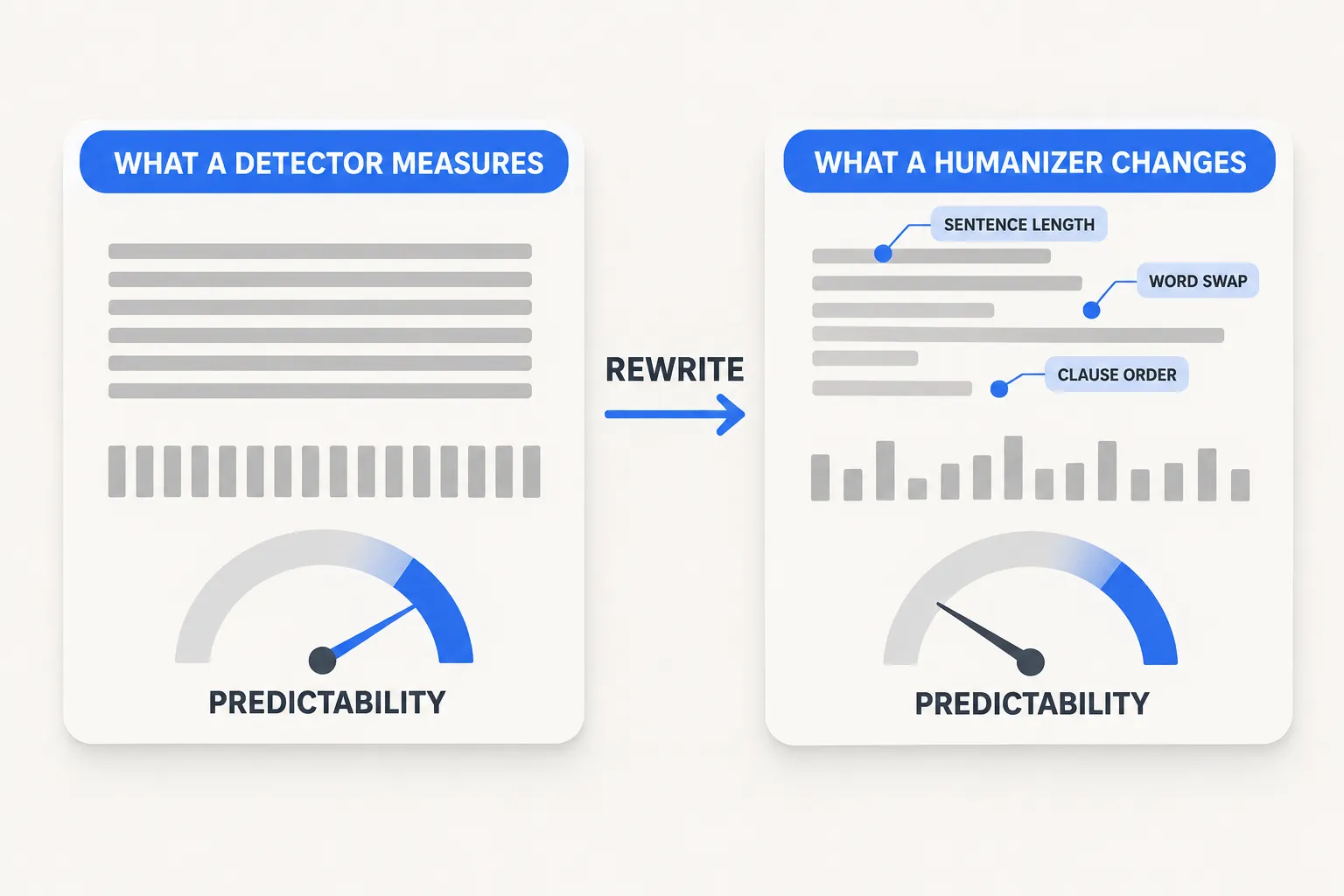
That one result explains most of the traffic now flowing to AI humanizer tools. An AI humanizer is a rewriting layer: you paste in text, it reworks the sentences so they look less statistically predictable, and the output is meant to read as though a person typed it from scratch. Sentence lengths get varied, vocabulary gets swapped, repeated structures get broken up, and the connective tics that language models overproduce get stripped out.
What it does not do is check whether the text is still true, whether it still says what you meant, or whether using it is appropriate where you are about to use it. Those three gaps are where people actually get hurt — not at the detector, but two steps later, when a rewritten paragraph goes back into a proposal, a thesis chapter or a client report carrying a figure that is no longer the figure you wrote.
Here is what these tools genuinely fix, what they break without telling you, and what to check before the text becomes a finished document with your name on it.
Perplexity is a measure of how predictable each word is given the words before it. Low perplexity means the text keeps taking the obvious next word — which is precisely what a language model is built to do, and precisely what most detectors score.
What an AI Humanizer Actually Changes in Your Writing
Strip away the marketing and these tools make a fairly short list of edits. Knowing the list matters, because every item on it is a change to your words, and some of your words are carrying facts.
Sentence length. Machine drafts cluster tightly, often between 15 and 25 words per sentence, with very little variation. Human writing swings — a four-word sentence next to a forty-word one. Rewriters deliberately reintroduce that swing, which researchers usually call burstiness.
Vocabulary. Out go the words models reach for far more often than people do: utilise, delve, leverage, navigate, realm, tapestry. In come plainer substitutes. On its own terms this is usually an improvement.
Connectives and scaffolding. Furthermore, moreover, in conclusion, it is important to note — heavily over-represented in generated text, and first against the wall.
Clause order and voice. Passive constructions flip to active, subordinate clauses move to the front or the back, two short sentences fuse, one long one splits.
Hedging. Models hedge symmetrically and constantly: while X holds, it is also worth considering Y. Rewriters break that symmetry, and this is the single riskiest edit they make — more on that below.
Deliberate roughness. Some tools add contractions, a sentence fragment, an em dash, occasionally a comma splice. Texture, essentially.
Notice what is missing from that list. Nothing in it verifies a claim, preserves a quoted passage, protects a defined term or keeps a number intact. The tool is optimising for how the text looks to a statistical model, not for what it says.
Why Detectors Flag Your Writing in the First Place
A plagiarism checker and an AI detector feel similar and work nothing alike. A plagiarism checker asks a question with a real answer: has this exact string of words appeared somewhere before? An AI detector asks a question with no real answer: would a model plausibly have produced this? It scores predictability and variation, then converts that into a percentage that looks far more authoritative than it is.
The vendors themselves have been reasonably candid about the limits. OpenAI launched its own AI Text Classifier in January 2023 and retired it that July, citing a low rate of accuracy; at the time it correctly identified only 26% of AI-written text while flagging 9% of human writing as machine-made. Turnitin publishes a document-level false positive rate under 1% for documents containing at least 20% AI writing, but around 4% at the sentence level — roughly one highlighted sentence in twenty-five turning out to be human-written after all.
One percent sounds tiny until you multiply it. Vanderbilt University did exactly that: it submitted roughly 75,000 papers in 2022, so a 1% error rate would mean about 750 students wrongly flagged, and it switched the detector off for the foreseeable future. The Stanford team behind the TOEFL study put it more bluntly still, with senior author James Zou describing current detectors as unreliable and easily gamed.
That cuts in two directions. If you are flagged on work you wrote yourself, the flag is weak evidence rather than proof — and reaching for a rewriting tool to clear it is treating a measurement error as a writing problem. If you are flagged on work a model did write, a lower score does not make the submission any more yours.
Treating a detector score as a pass or fail gate and rewriting until the number drops. Every pass strips specificity, so you end up with text that scores better and says less — and the score was never the thing being graded.
Can an AI Humanizer Get You Past a Detector?
Usually, at the moment, yes — and that is the least useful fact in this article.
It is unstable in three ways. Detectors retrain; your submitted file does not, so a document that scored clean in March can be re-run in September against a newer model. Institutions and publishers have also shifted attention from scores toward process: revision history, intermediate drafts, a viva, a two-minute conversation about your own argument. And rewriting tools are themselves generated text, which means they leave patterns of their own behind.
The more useful question is not whether a score will drop but whether rewriting is the right move at all. That depends entirely on which of three situations you are in.
| Your situation | What rewriting actually does | Worth doing? |
|---|---|---|
| AI use is allowed and you have disclosed it | Improves readability, removes machine tics | Yes — this is ordinary editing |
| AI use is permitted but your own writing reads flat | Adds rhythm and plainer vocabulary | Yes, with a careful fact check afterwards |
| AI use is not permitted (graded coursework, many journals, contracts with originality clauses) | Hides the source rather than changing it | No — the rule is about authorship, not detection |
The third row is worth sitting with. A rewriting pass does not convert machine text into your work; it changes how the text looks to a classifier. If the rule you are working under is about who wrote the thing, a lower score answers a question nobody asked.
Non-native English speakers sit in a genuinely unfair spot here, and the Stanford result is the evidence for it. Rewriting your own honest work so a biased classifier stops misreading it is a reasonable response to a broken measurement — but keep your drafts anyway, because drafts are the only thing that settles the question properly.
What Breaks When You Run a Document Through a Rewriter
This is the part the tool pages skip. Six things drift, in rough order of how often they cause real damage.
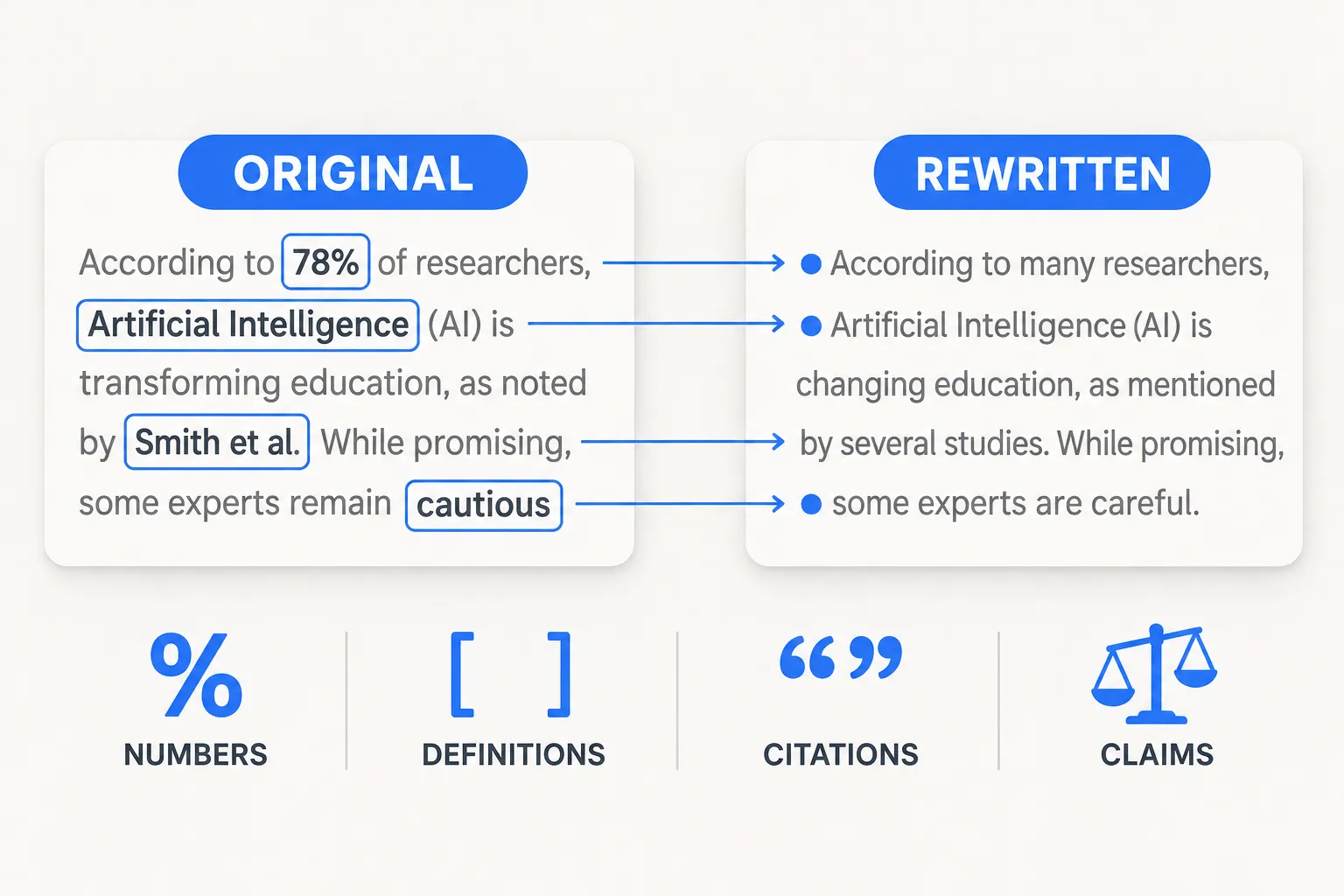
Numbers and units. A rewriter has no concept of a figure being load-bearing. Approximately 4% becomes a small proportion. Within 30 days becomes promptly. A date range collapses into recently. Bare numbers usually survive; qualified ones rarely do.
Defined terms. Contracts and policies build meaning by defining a capitalised term once and then reusing it exactly. Rewriting the Services into the work provided does not merely read differently — it unhooks the sentence from the definition that gave it force.
Citations and attribution. Author names survive. Attribution strength does not. Zou and colleagues found becomes some researchers suggest, which is a much weaker claim about a specific study. Worse, anything inside quotation marks that gets paraphrased is now a misquote with the quotation marks still around it.
Named things. Standards, products and version numbers get normalised or expanded. ISO 32000 turns into the PDF standard. A specific model name turns into a generic one.
Resume and application keywords. Applicant tracking systems match on literal strings. Managed AWS infrastructure rewritten as oversaw cloud systems has lost both terms the filter was looking for, which is the exact opposite of what the candidate wanted — worth reading alongside what an automated resume review actually catches.
Everything that was not text. The output comes back as a flat block. Headings, bullet levels, tables, footnotes, superscript citation markers and page breaks do not survive the round trip, and rebuilding them is usually the slowest part of the whole job.
A freelancer rewrites one paragraph of a 14-page proposal so it reads less mechanically. The output is better prose. It also turns payment due within 30 days of invoice into payment follows promptly after invoicing. The client signs. Four months later there is a disagreement about what promptly meant, and no term left to point at.
A Safer Way to Rewrite Without Losing the Facts
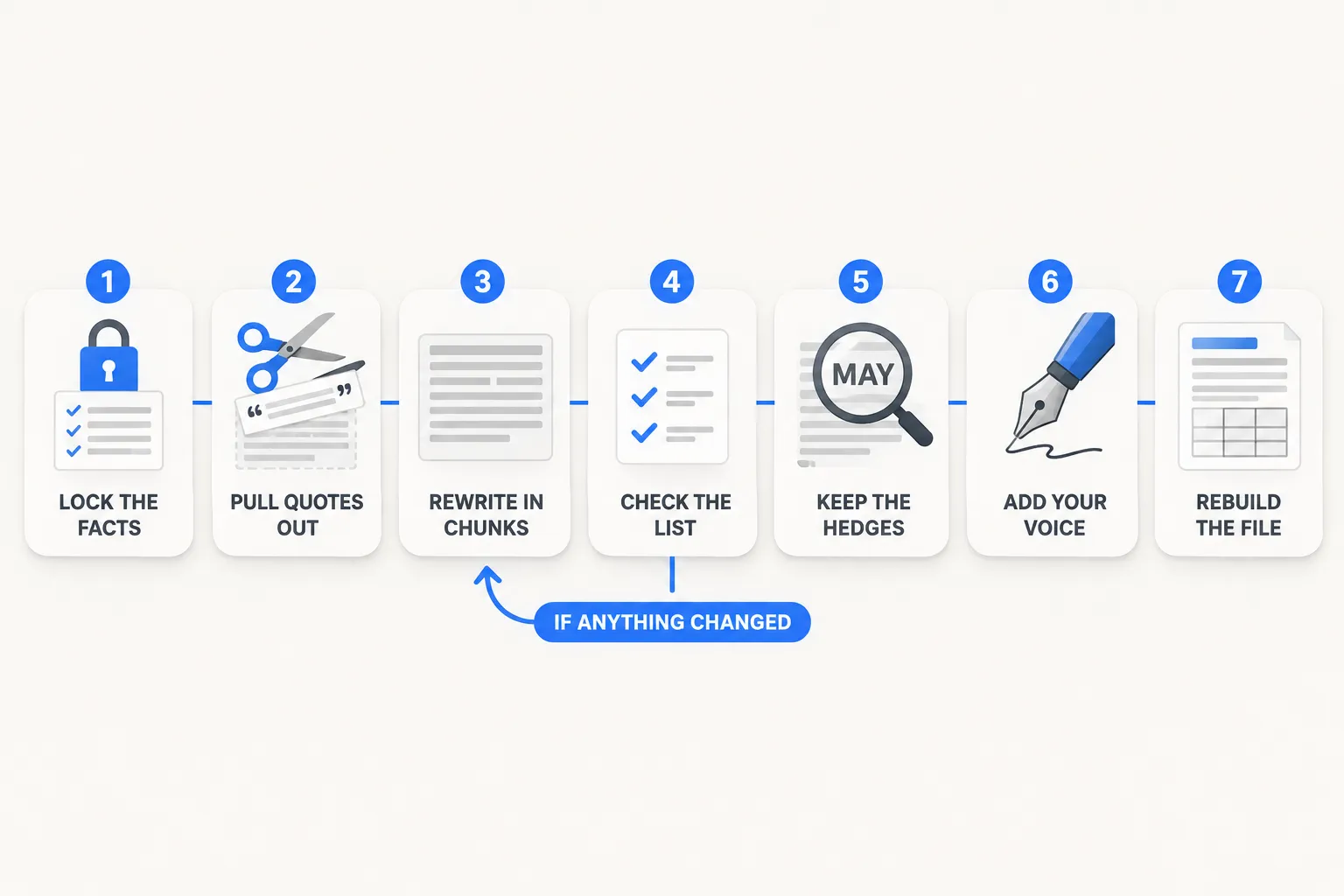
Seven steps. They take about ten minutes on a page of text and they catch nearly all of the drift above.
- Lock the facts first. Before pasting anything, copy every number, date, proper noun, defined term and citation into a short list in a separate file. That list is your checklist, and building it takes two minutes.
- Pull the quoted material out. Anything inside quotation marks, any clause lifted from a contract, any wording from a standard — cut it, leave a marker in its place, paste it back afterwards. Quoted text must never be rewritten.
- Work in small units. One or two paragraphs at a time, never a whole document. Long inputs get compressed, and compression drops detail without announcing it.
- Check the output against your list. Every item has to still be there, in the same form. This is the step that catches approximately 4% becoming a small proportion.
- Hunt specifically for lost hedges. Find each may, can, often, typically and roughly in the original and confirm it survived. A removed hedge turns a careful statement into a claim.
- Read it aloud. Anything that sounds like it is avoiding a word usually is — that is where a specific noun was swapped for a vague one.
- Rebuild the document last, then proof the rebuild. Headings, numbering, footnote markers and tables all need a second look after reassembly, and that pass finds errors the text pass missed.
Keep your original draft as a separate dated file and leave its version history alone. If your authorship is ever questioned, a revision trail showing the work being built is worth far more than any detector score — and process evidence of exactly that kind is what most institutions now ask for first.
One Paragraph, Four Things That Drifted
Here is the whole problem in a single sentence. The original, from a short research summary:
Across 91 TOEFL essays, seven detectors misclassified more than 61% as AI-generated, which may indicate that perplexity-based scoring penalises simpler vocabulary.
After one rewriting pass:
Researchers found that detectors often got non-native student essays wrong, showing that this kind of scoring unfairly punishes plainer writing.
Four separate losses in one sentence. The sample size is gone. The 61% figure is gone. The method — perplexity-based scoring — is gone, replaced by this kind of scoring, which now refers to nothing. And may indicate has become showing: a hedge promoted to a finding.
The second version reads more naturally. It is also no longer citable, no longer checkable, and it claims more than the underlying study supports. In a blog post that is sloppy. In a grant report, a medical summary or anything a regulator might read, it is a different category of problem. And if your source material is a scan rather than live text, there is an extra hurdle before you even start — a scanned page has no real text to rewrite until it has been read properly first.
What People Get Wrong About Humanized Text
Running it twice. The second pass rewrites the rewrite, and drift compounds. Two passes reliably produce text that is vaguer than one pass and no measurably safer.
Using it to fix a false positive. If you wrote the thing yourself, rewriting your own voice out of it to satisfy a classifier is a bad trade. Keep the drafts, show the history, and push back on the score instead.
Touching regulated or legal text at all. Contracts, consent forms, medical instructions, financial disclosures, insurance wording — these are documents where the exact phrasing is the product. They get edited by a person or they do not get edited.
Trusting a score from the vendor selling the rewrite. A tool that both rewrites text and certifies it as human-written is grading its own homework. If you are going to check at all, check somewhere independent, and remember what the error rates above actually mean.
Forgetting the file itself. The words are only one layer. A finished document still carries its metadata, its author field, its creation and modification timestamps and sometimes its edit history. People have been caught by file properties rather than prose more than once.
Assuming it improves quality. It changes surface statistics. An accurate but dull paragraph comes back slightly less accurate and slightly less dull. If what you want is writing that sounds like you, no rewriting layer can supply it, because it has never read a word you wrote.
The Short Version
These tools do one narrow job well: they take the mechanical rhythm out of generated prose. That is a real thing to want, and plenty of legitimate uses exist — polishing a draft you have disclosed, getting the stiffness out of your own second-language writing, making a rough first pass less obviously machine-shaped.
The cost is that they edit meaning while they edit style, silently, and the places they damage most are the places that matter: figures, defined terms, attributions and hedges. Lock those down before you paste, verify them after, and rebuild the document last. Treat a detector score as weather rather than a verdict — unreliable enough in both directions that neither a high number nor a low one should change what you actually submit.
- Humanizers rewrite for statistical variation, not accuracy — they cannot tell a load-bearing number from a filler word.
- Detectors score predictability, not authorship; OpenAI retired its own classifier and several universities have switched theirs off.
- The most dangerous edit is a removed hedge: may reduce quietly becoming reduces.
- Lock your facts, quotes and defined terms into a checklist before rewriting, then verify them line by line afterwards.
- Formatting never survives the round trip, so budget time for rebuilding headings, tables and footnotes.

MojoPDF
Taj
A professional SaaS founder offering great value to it's customers.
Frequently Asked Questions
It depends entirely on your institution's policy, and the policy is almost always about authorship rather than detection. If AI-assisted drafting is permitted with disclosure, rewriting for clarity is ordinary editing. If it is not permitted, a rewriting pass does not make the work yours — it only makes the source harder to identify.
Sometimes, and the answer keeps changing because detection models are retrained while your submitted file stays frozen. A document that scored clean in one term can be re-run later against a newer model. Increasingly, institutions weigh draft history and process evidence more heavily than any single score.
Frequently, and usually in small ways you will not notice on a skim. The common losses are qualified numbers, defined terms, attribution strength and hedging words. Compare the output against a list of your facts before you use it anywhere that matters.
Detectors score how statistically predictable your text is, not where it came from. Plain vocabulary, consistent sentence lengths and a formal register all push that score up. Stanford's research found this hits non-native English writers hardest, with over 61% of TOEFL essays misclassified as machine-written.
Treat it the same as emailing the text to a stranger. Many rewriting services process input on their own servers and some retain it for model improvement unless you opt out. For contracts, HR files, medical records or anything under NDA, check the retention policy first or do not paste it at all.
Usually the opposite. Tracking systems match literal strings like job titles, certifications and tool names, and a rewriter replaces exactly those with synonyms. If you rewrite a resume, restore every tool, technology and job title to the wording the posting uses.
Once, if at all. A second pass rewrites the output of the first, so meaning drift compounds while the readability gain shrinks. If one pass has not produced something usable, the underlying draft is the problem rather than the surface wording.
No, and it is not evidence of anything much. A zero means a probabilistic classifier found no statistical signal it recognises, which says nothing about who typed the words. Dated drafts and version history are the only documentation that actually demonstrates authorship.
It can. Heavy grammar correction smooths the variation detectors read as human, so polished writing sometimes scores higher than messy writing. This is one reason several universities have told staff not to treat a score as grounds for an accusation on its own.
Produce your process: dated drafts, revision history, research notes, browser or library records. Ask which detector was used and what its documented false positive rate is. Turnitin itself reports roughly a 4% false positive rate at the sentence level, which is a reasonable thing to raise in that conversation.
Most are trained and tuned on English, and quality drops noticeably elsewhere. In languages with heavy inflection or formal register conventions, the rewrite tends to break agreement or shift politeness level. Have a fluent speaker read the output before it goes anywhere public.
Search engines target unhelpful content rather than AI assistance as such, so the production method is less important than whether the page is accurate and useful. The practical SEO risk from rewriting is losing the specific figures, product names and technical terms that made the page worth ranking in the first place.